
Rights
The Rights feature allows administrators to define and manage Open Data Rights Language (ODRL) policies for digital assets. These policies govern how assets can be used, where they can be distributed, and when their usage rights expire.
By centralizing rights management, you ensure legal compliance across your entire asset library. You can track which assets are governed by specific agreements, monitor upcoming expirations, and require users to acknowledge legal terms before accessing sensitive content.
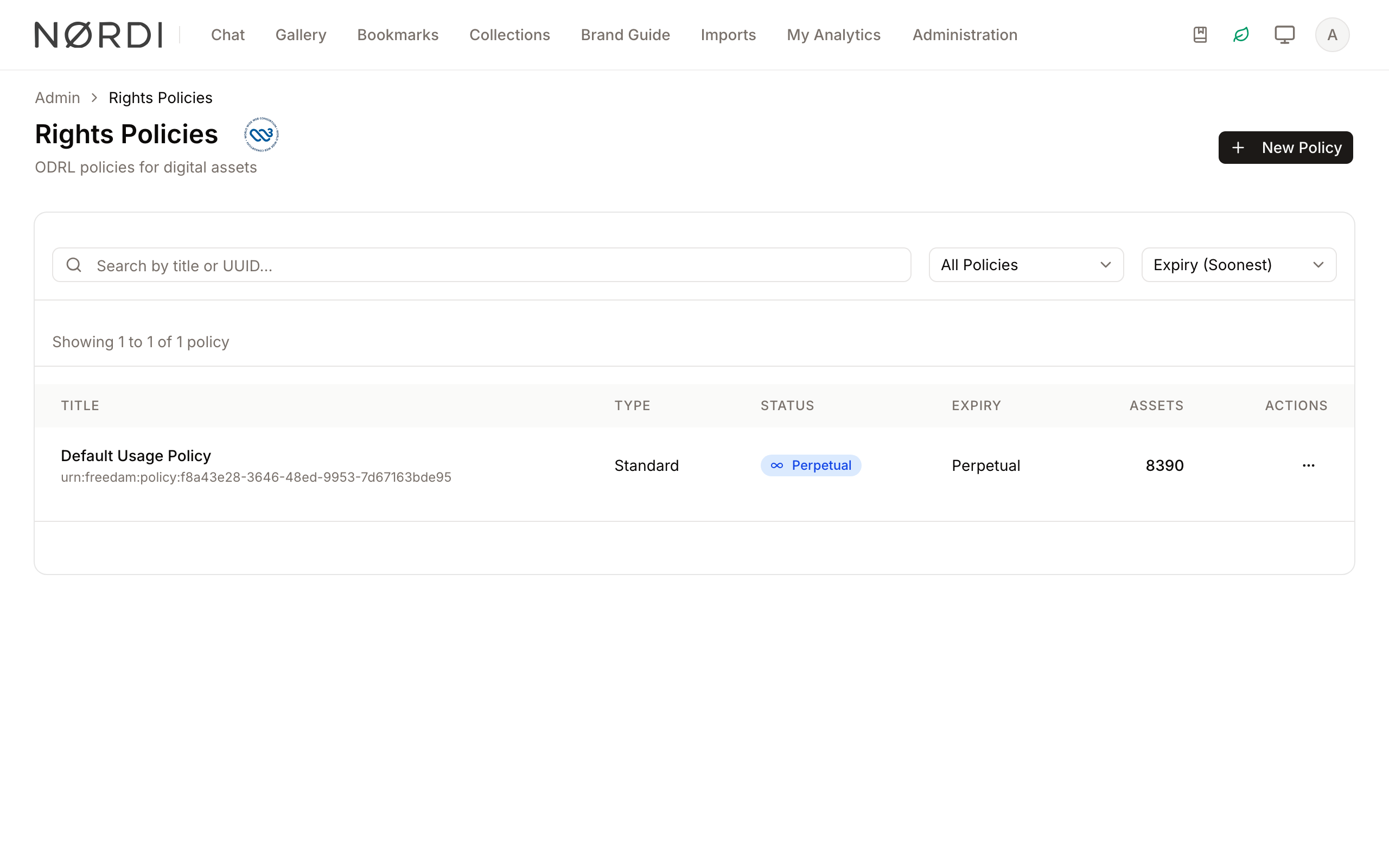
Page Overview
- Purpose: To create a standardized library of usage rights that can be applied to assets.
- When to use it: Use this page when you need to add new licensing terms, update existing contract dates, or audit which assets are currently under specific legal restrictions.
- What you can do here:
- Create new rights policies from scratch or templates.
- Filter policies by status (Active, Expiring Soon, Expired, Perpetual).
- Search for specific policies by title or unique ID.
- Monitor the number of assets assigned to each policy.
- Manage legal acknowledgment requirements for asset access.
Page Layout
- Top bar: Contains the page title, a link to the W3C ODRL specification, and the New Policy button.
- Main area: A searchable and filterable table listing all defined policies, showing their type, status, expiry date, and the count of associated assets.
- Action menus: Located at the end of each row, providing access to view details, edit, or delete specific policies.
Main Features
Policy Status Tracking
- What it's for: Automatically categorizes policies based on their expiration dates.
- Typical use: Quickly identifying policies that are "Expiring Soon" to prepare for contract renewals.
- Result: Policies are labeled with color-coded badges (e.g., green for Active, red for Expired) for immediate visual reference.
Asset Association Count
- What it's for: Shows exactly how many assets are currently governed by a specific policy.
- Typical use: Checking the impact of a policy change or identifying if a policy is safe to delete.
- Result: Displays a numerical count in the "Assets" column; policies with a count higher than zero cannot be deleted.
Search and Filtering
- What it's for: Finding specific policies within a large library.
- Typical use: Searching for a policy by its UUID or filtering the list to show only "Perpetual" rights.
- Result: The table updates in real-time to show only matching policies.
Detailed Feature Documentation
New Policy Creation
- Purpose: To define a new set of usage rules and timeframes for assets.
- Where to find it: In the top bar, look for the New Policy button.
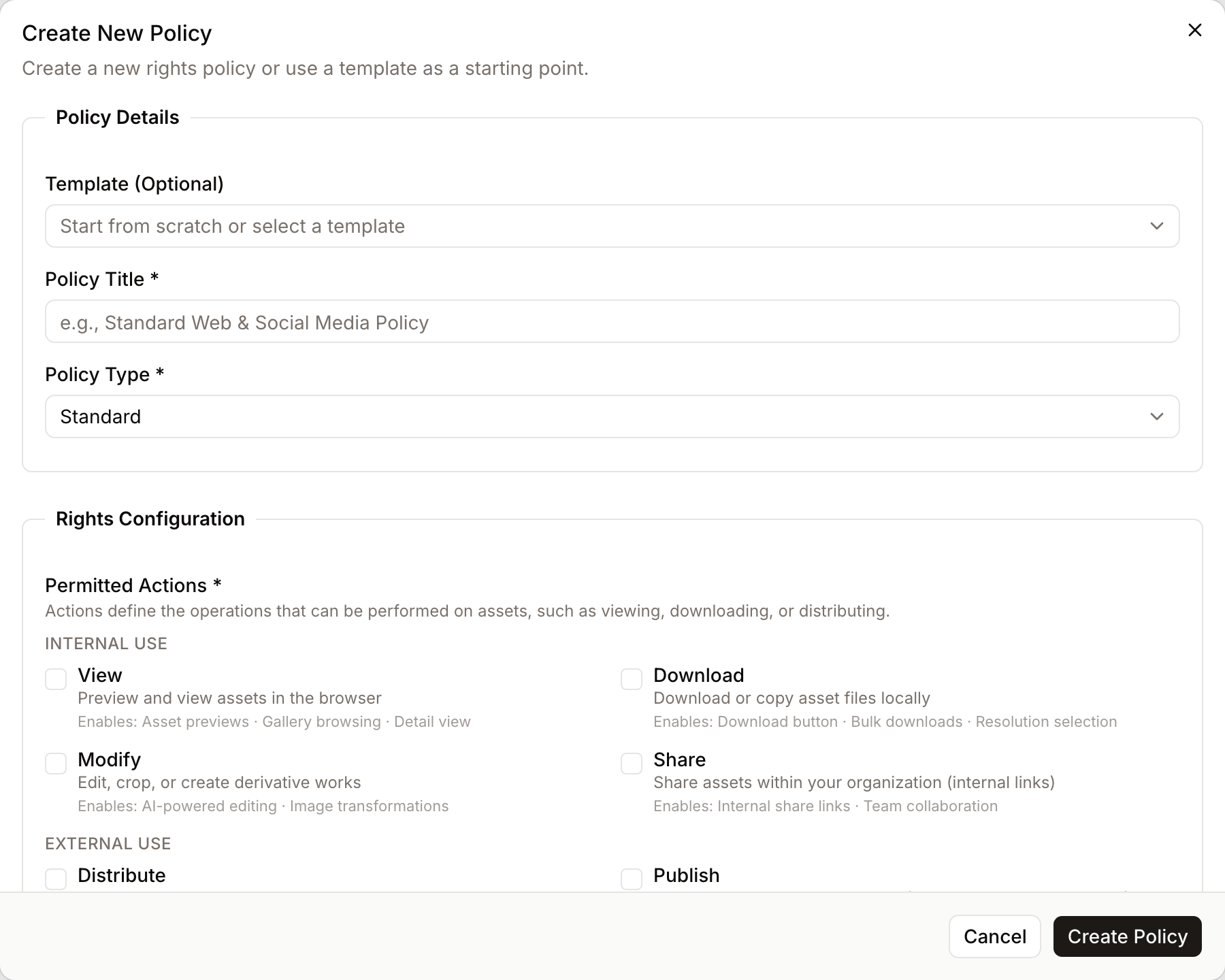
- What you'll see: A dialog window opens where you can select a template or enter custom policy details.
How to use it:
- Click New Policy in the top bar.
- Enter a Title for the policy.
- Select the Policy Type (e.g., Set, Offer, or Agreement).
- Define the Actions, Territories, and Channels allowed under this policy.
- Set an Expiry date if the rights are not perpetual.
- Click Save (or the primary action button in the dialog).
Policy Details View
- Purpose: To see a comprehensive breakdown of a policy and a list of all assets assigned to it.
- Where to find it: In the table, click the MoreHorizontal (three dots) icon and select View Details.
- What you'll see: A detailed overlay showing the full policy configuration and a list of "Assigned Assets."
How to use it:
- Locate the policy in the main table.
- Click the MoreHorizontal button at the end of the row.
- Select View Details.
- Review the assigned assets list at the bottom of the view.
Complete Workflows
Workflow: Deleting an Unused Policy
- Goal: Remove an obsolete policy from the system.
- Prerequisites: The policy must not be assigned to any assets (Asset count must be 0).
Steps:
- Locate the policy in the Rights Policies table.
- Check the Assets column to ensure the count is 0.
- Click the MoreHorizontal icon in the Actions column.
- Select Delete.
- In the confirmation dialog, click Delete.
- Expected result: The policy is removed from the list and a success message appears.
- If it doesn't work: If the Delete option is disabled, the policy is still assigned to assets. You must remove the policy from those assets before it can be deleted.
Workflow: Finding Expiring Rights
- Goal: Identify all rights policies that will expire soon.
- Prerequisites: None.
Steps:
- Go to the Rights Policies page.
- Click the All Policies dropdown filter.
- Select Expiring Soon.
- Click the Sort dropdown and select Expiry (Soonest).
- Expected result: The table filters to show only policies nearing their end date, ordered by the closest date first.
Who can use it
This page is reserved for people with the "Manage rights policies" permission. The catalog description reads: "create and manage rights policies - define usage rights, permissions, and constraints for assets." Applying an existing policy to an asset is controlled by a separate "manage rights on assets" permission, and viewing the policy information attached to an asset is a lighter "view rights" permission. This split lets you give content managers the power to tag assets with existing policies without also granting them the ability to redefine legal terms.
Limits and guardrails
- No deletion of policies in use: A policy cannot be deleted while it is still attached to any asset. The delete button is disabled and the details dialog shows exactly how many assets depend on it. This protects your library from losing the legal context that governs its files.
- Acknowledgement versioning: When a policy requires a legal acknowledgement from users, the acknowledgement has a version number. Updating the acknowledgement text raises the version, which means users who previously accepted the old text will be asked to re-accept before downloading.
- Multilingual acknowledgements: Acknowledgement text can be translated per active language in your workspace. Users see the version in their preferred language if available, otherwise they see the tenant default.
What happens behind the scenes
- Assigned-asset preview: When you open the details view of a policy, the first 24 sample assets currently covered by that policy are loaded into a preview grid with thumbnails. This gives you an instant visual check of what you're about to edit, without having to leave the page. The dialog links out to the full list in the gallery if you need to see every asset.
- Template library: New policies can be started from a curated list of templates (for example "Editorial Use Only", "Perpetual Internal Use", etc.). Each template pre-fills the policy type, allowed actions, territories, channels, prohibitions, duties, and a sensible expiry strategy.
- Status is computed from dates: The green "Active", amber "Expiring Soon", red "Expired", and blue "Perpetual" badges are derived live from the expiry date and your workspace's "expiring soon" threshold, so the list is always up to date without anyone having to flag policies manually.
Tips and Best Practices
- Use Descriptive Titles: Name policies after the contract or vendor they represent (e.g., "Getty Images - Standard License 2024") to make searching easier.
- Check Asset Counts: Before editing a policy, always check the Assets count. Changes to a policy will immediately affect all assets assigned to it.
- Clear Search: Use the X icon in the search field to quickly return to the full list of policies.
Troubleshooting
Issue: Cannot delete a policy
- Symptoms: The Delete option is greyed out or an "Alert" dialog appears saying "Cannot Delete Policy."
- Cause: The policy is currently assigned to one or more assets.
- Fix:
- Click View Details on the policy to see the list of Assigned Assets.
- Navigate to those assets and remove or change their assigned rights policy.
- Return to the Rights page and attempt the deletion again.
- Prevention: Regularly audit your policies to ensure assets are moved to new policies before old ones expire.
Issue: No results found
- Symptoms: The table displays an "AdminEmptyState" with the message "No policies found."
- Cause: Active filters or search queries are excluding all policies.
- Fix:
- Click the Clear search (X) button in the search bar.
- Reset the status filter to All Policies.
- Prevention: Check the "Results Summary" text above the table to see how many total policies exist versus how many are currently shown.