
AI Chat Search
AI Chat Search lets you find your digital assets by describing what you need in plain English, the way you would ask a teammate. Instead of opening the Gallery, picking a dimension filter, picking a colour, picking a date, and then combining them with AND/OR, you just type:
"Find landscape photos with sunset colours uploaded in the last month."
The assistant reads your request, figures out which filters match it, runs the search for you, and shows the matching assets right inside the conversation. If the first answer isn't quite right, you can refine it by chatting back - "only the portrait ones", "also include videos", "now just from the Spring campaign" - and the assistant keeps building on what's already on screen.
This page is ideal for marketers and content managers who know what they want but don't want to spend time wiring up complex filter groups by hand. Every chat session is private to you, and everything the assistant finds can be opened in the full Gallery whenever you want the bigger picture.
Page Overview
- Purpose: To provide a conversational interface for asset discovery and filtering.
- When to use it: Use this when you have a specific search intent but don't want to manually configure multiple filter groups in the gallery, or when your request mixes several kinds of criteria (content, colour, date, metadata) at once.
- What you can do here:
- Type natural language queries to find assets.
- See matching assets inline as a mini gallery, with previews, status badges, and quick download/share actions.
- View a history of previous search conversations grouped by recency.
- Refine search results through follow-up messages that build on what's already found.
- Export chat-generated filters directly to the full Gallery view for bulk actions.
- Rename conversations so you can come back to them easily.
Page Layout
- Top bar: Displays the "Chat" title, the current Session ID (if active), and primary actions like "Open in Gallery" and "History."
- Main area: The central scrollable region where your conversation with the AI appears, including your requests, the AI's responses, a visual summary of filters added/removed/changed, and the matching assets.
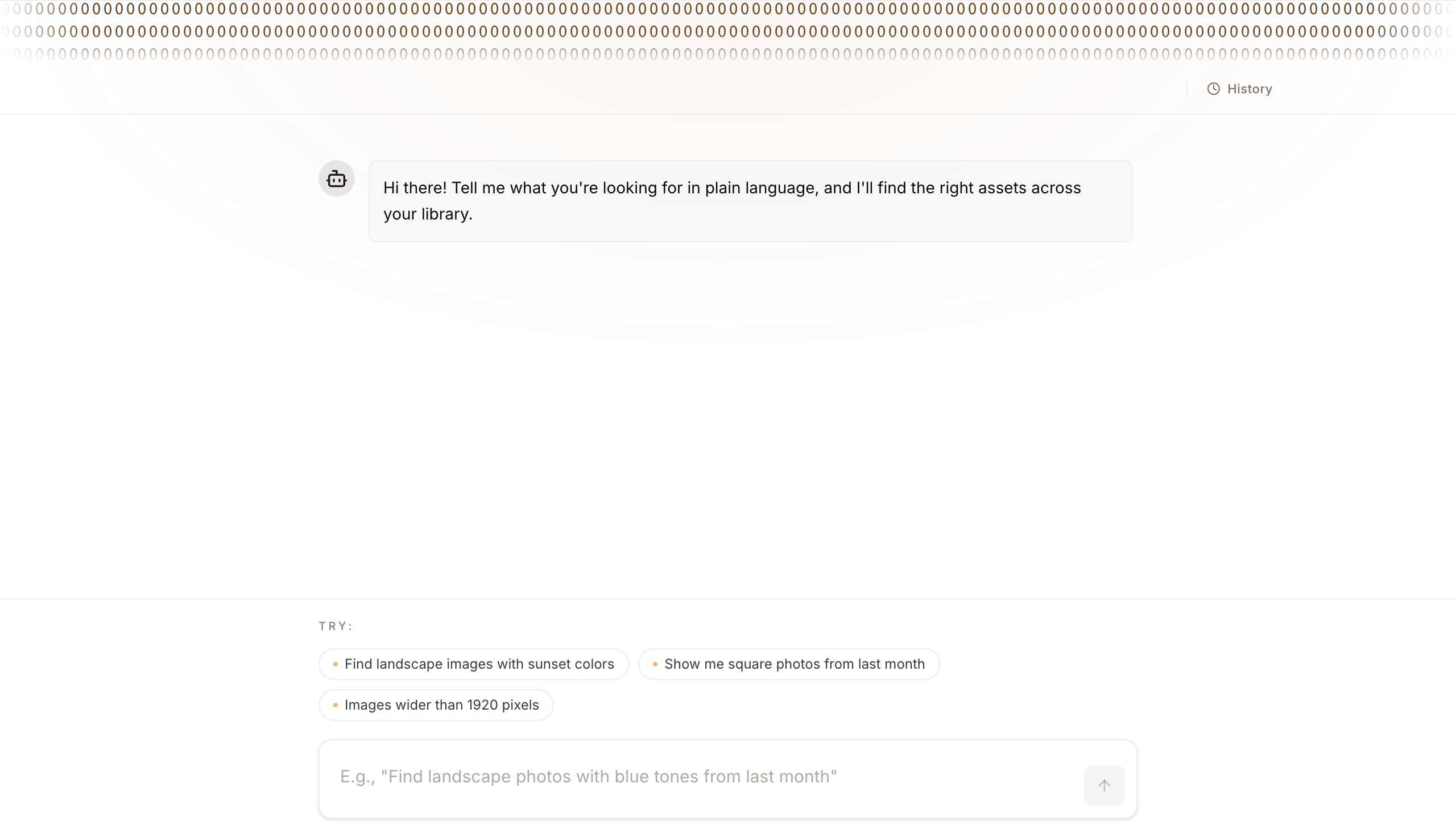
- Bottom input area: Contains the text field for typing messages, suggested query chips for new chats, and the send button.
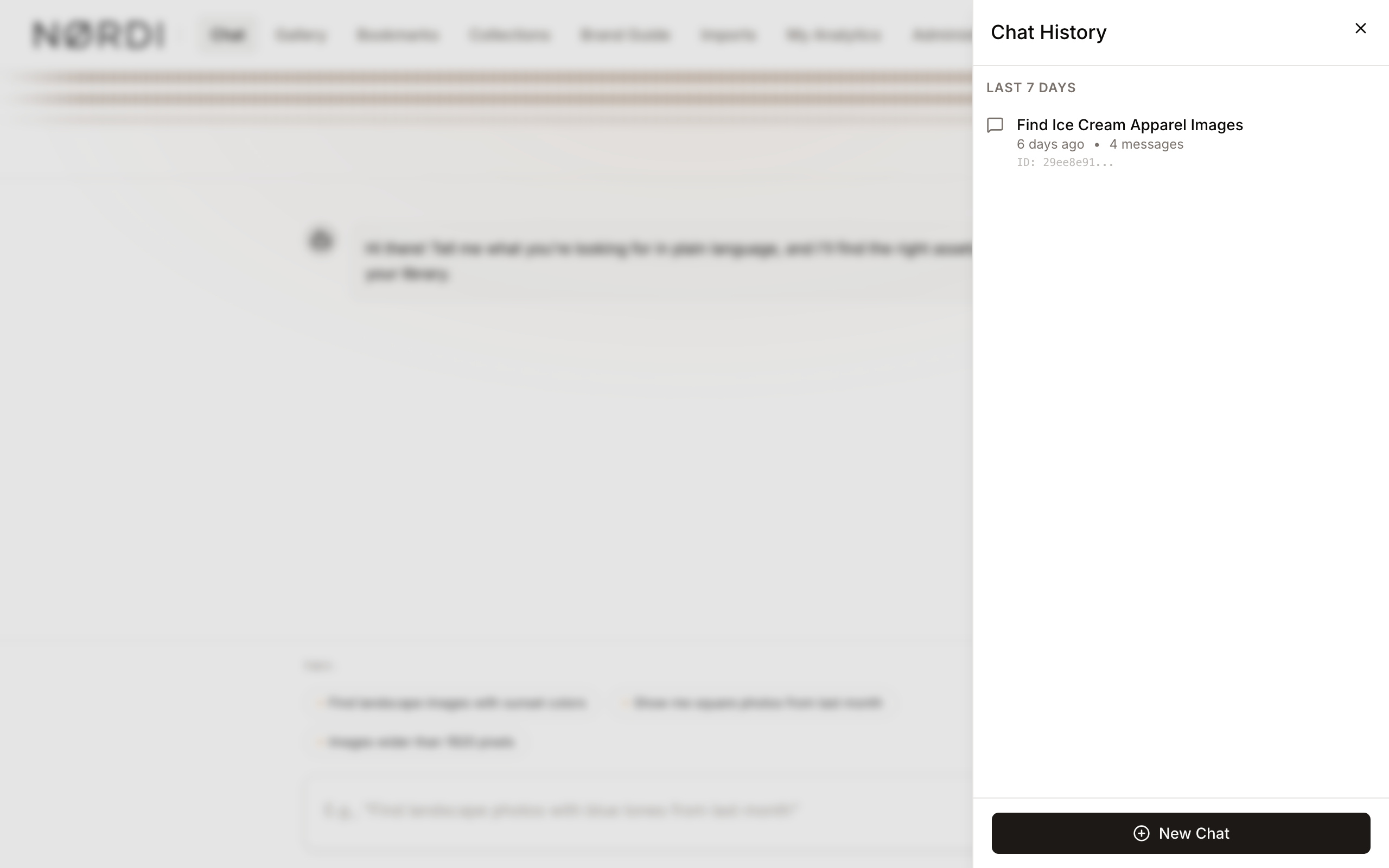
- Right sidebar: A slide-out panel (accessed via the "History" button) that lists your past conversations grouped by date.
Main Features
Natural Language Input
- What it's for: Converting your written descriptions into an actionable asset search.
- Typical use: Typing "Find landscape images with sunset colors" into the message field.
- Result: The assistant identifies the relevant assets and shows them as a filtered gallery inside the reply.
Chat History Management
- What it's for: Keeping track of previous searches and organizing your work.
- Typical use: Clicking the "History" button to return to a search you performed yesterday.
- Result: Opens a sidebar where you can switch between, rename, or delete past sessions.
Gallery Integration
- What it's for: Moving from a conversation to a full-screen browsing experience where you can apply bulk actions (tagging, downloading, adding to a collection, sharing, etc.).
- Typical use: Clicking "Open in Gallery" after the AI has successfully filtered your assets.
- Result: Redirects you to the Gallery page with all filters from the chat automatically applied and visible in the filter bar. From there you can refine further, save the search, or select assets for bulk operations.
A gallery of example prompts you can try
You don't need to learn a special syntax - just describe what you want. Here's a range of prompts that work well, from simple to quite rich:
Simple content searches
- "Find images of bread knives."
- "Show me photos with happy people."
- "Sunset over water."
Content plus look and feel
- "Find landscape images with sunset colours."
- "Warm, golden-hour photos of food on wooden surfaces."
- "Cosy indoor scenes with natural light."
Technical constraints
- "PNG files uploaded in the last 48 hours, wider than 1920 pixels."
- "Square photos from last month."
- "Videos longer than 30 seconds added this week."
Business and campaign data
- "Spring campaign photos shot outdoors with natural light and a human subject."
- "Products from the Nordic Nest or Muuto brand."
- "Assets by the designer Henning Koppel."
- "Kitchen-category products with the hero-image tag."
Layered, realistic marketer prompts
- "Compare these two candidates for our homepage hero - find banner-ratio images with a single person, no text overlay, from the autumn collection."
- "Portrait-orientation product photos against a white background, approved for external use."
- "Everything tagged 'behind the scenes' added in the last 90 days."
Under the hood the assistant chooses the right search technique for each part of the request - keyword matching, meaning-based (semantic) matching, colour palette matching, date ranges, dimension checks, and your workspace's custom metadata fields like brand, designer, product line, or campaign. You don't need to know which is which; you just describe what you're after.
Detailed Feature Documentation
Chat Input Field
- Purpose: To enter search queries and interact with the AI.
- Where to find it: At the bottom of the main chat screen.
- What you'll see: A text area with the placeholder "E.g., 'Find landscape photos with blue tones from last month'".
How to use it:
- Click inside the Chat message input box.
- Type your search request.
- Press Enter (or click the Send message icon) to submit. Use Shift+Enter if you need to start a new line.
The input box grows as you type and caps at roughly eight lines before it scrolls internally, so even a long, detailed prompt stays readable. Empty messages are ignored, and the send button greys out while the assistant is thinking so you don't double-send.

Suggested query chips
When you open a brand-new chat, a short "Try:" row appears above the input with clickable example prompts such as "Find landscape images with sunset colors" or "Images wider than 1920 pixels." Clicking one drops the text into the input so you can edit it or send as-is. These chips disappear the moment you start typing or send your first message, keeping the screen focused on the conversation.
Assistant replies, filter chips, and inline results
Each answer from the assistant contains a short written explanation of what it did, followed by a few visual cues that make the search easy to understand at a glance:
- Filter chips show the filters it Added, Removed, or Modified in response to your message. Colour filters appear as a tiny colour swatch so you can see the shade.
- Matching assets appear underneath as a small gallery grid (2 to 6 columns depending on screen size). Each card shows the same preview, status badges, and quick actions (download, share) as the main Gallery, and clicking a card opens the full asset detail view without leaving chat.
- Result count in the form "Showing 10 of 1,284 assets" tells you how big the full result set is. The "Open in Gallery" button in the top bar lets you see all of them.
When there are no results - or only a few
The assistant goes out of its way to explain what happened when a search doesn't work, rather than just saying "no results."
- No results: The reply includes a filter breakdown - a per-filter count showing how many assets each individual filter matches on its own (for example, "3,422 assets match 'Colour: sunset orange'" but "0 assets match 'Orientation: square' combined with the rest"). Below that, up to three suggested alternatives appear, such as broadening a date range, dropping a size restriction, or searching for each filter on its own using OR.
- Only a few results (1 to 4): The reply shows a "You could expand your search by adding" list of tags that commonly appear on the assets that did match, letting you widen the net in one click. For example, finding two "lavender field" photos might suggest adding "summer", "purple", or "rural".
Multi-turn conversations: what the assistant remembers
AI Chat is conversational on purpose. Each session accumulates context as you go:
- Filters built so far: If you first say "photos from Spring 2026" and then follow up with "only the blue ones", the colour filter is added on top of the date filter - your existing work isn't thrown away.
- Resolved ambiguous words: Words like "portrait" and "landscape" can mean either an orientation or a subject. The first time you use one, the assistant may ask a clarifying question. After you answer, that interpretation sticks for the rest of the session - you only have to disambiguate once.
- Conflicts: If two instructions contradict (e.g. "only portrait" and later "only landscape"), the reply includes a "Warning: some filters may conflict" note so you can choose which one wins.
- Recent turns: The assistant looks at roughly the last five exchanges when deciding how to interpret your next message. Much older messages in the same session are not used as context, which keeps answers fast and focused.
Starting over (the reset)
If you want to throw away the filters and start clean without losing the conversation, just say so: "reset the filters", "start over", or "clear everything" are all understood and produce an empty filter state. If you want an entirely new conversation - new title, new history entry - open the History sidebar and click New Chat at the bottom.
Session History Sidebar
- Purpose: To browse, resume, or manage previous chat sessions.
- Where to find it: Click the History button in the top right corner.
- What you'll see: A panel sliding in from the right showing sessions grouped by Today, Yesterday, Last 7 Days, Last 30 Days, and Older. Each row shows the session title, when it was last active, how many messages it contains, and a short ID for support purposes.
How to use it:
- Click History to open the list.
- Click any session title to load that conversation - the full message history and filter state come back exactly as you left them.
- To start fresh, click the New Chat button at the bottom of the sidebar.
The bottom of the panel shows a running total - "12 conversations" - so you can see how much history you've built up. There's no hard cap on how many sessions you can keep; they stay until they expire (see below) or you delete them.
Auto-titled sessions
You don't need to name conversations yourself. A couple of seconds after your first exchange, the assistant reads what you asked and what it found, and quietly assigns a short, descriptive title - for example, "Blue landscape photos from March" or "Henning Koppel designer products" - which appears in the sidebar and (briefly) in the top bar. The title is capped at around 50 characters.
If the automatic title isn't quite right, you can rename it at any time (see below).
Session Actions (Rename/Delete)
- Purpose: To organize your history by giving sessions meaningful names or removing old ones.
- Where to find it: Inside the History sidebar, hover over a session and click the Session options (three vertical dots) icon.
- What you'll see: A dropdown menu with "Rename" and "Delete" options.
How to use it:
- Open the History sidebar.
- Click the Session options icon next to a chat.
- Select Rename to edit the title inline. Press Enter to save or Escape to cancel. Blank titles or unchanged values simply cancel.
- Select Delete and confirm in the popup dialog to permanently remove the session and all its messages.
Deletion is not reversible. If your workspace administrator has turned off session deletion, the Delete option won't appear - in that case, renaming is still available.
Copying the Session ID
Each active session has a short identifier shown under the "Chat" title on desktop screens (for example, "Session: 8b2f0e1a..."). Click it to copy the full ID to your clipboard - handy if you need to report an issue to an administrator, because it lets them find your exact conversation in the AI operations dashboard.
Complete Workflows
Workflow: Finding Specific Assets and Viewing in Gallery
- Goal: Use AI to filter assets and then use the Gallery's bulk tools on those results.
- Prerequisites: You must be logged in and have chat features enabled.
Steps:
- Navigate to the Chat page.
- In the Chat message input, type "Show me all square photos from last month wider than 1920 pixels".
- Click the Send message button.
- Once the assistant confirms the filters, click Open in Gallery in the top bar.
- Expected result: You are redirected to the Gallery, and the filter bar shows the exact rules generated by the chat. You can now select assets and run bulk operations such as download, tag, share, or add to a collection.
Workflow: Resuming a Previous Search
- Goal: Continue a search conversation from a previous day.
- Prerequisites: Existing chat history.
Steps:
- Click the History button in the top bar.
- Locate the desired session under the Yesterday or Last 7 Days headings.
- Click the session title.
- Type a follow-up message like "Now only show the ones that are blue" in the input field.
- Expected result: The chat loads the previous messages and applies the new refinement to the existing search.
Workflow: Asking a compare-style question
- Goal: Narrow down a shortlist of candidates for a specific placement.
- Prerequisites: Assets tagged, captioned, or with relevant metadata.
Steps:
- Start a new chat and type: "Find banner-ratio images of a single person, outdoor, no on-image text, from the autumn collection."
- Review the mini gallery; click any card to open the asset detail.
- Reply: "Only the ones where the subject is looking at the camera."
- When you're down to a manageable set, click Open in Gallery to compare side by side at larger sizes.
How AI Chat fits with Gallery search
AI Chat and the Gallery filter bar are two ways of building the same kind of search: both produce a set of filter rules that narrow your assets. They are designed to complement each other rather than compete.
- From Chat to Gallery: The Open in Gallery button sends the current filter state to the Gallery, where every rule becomes an editable chip. This is the fastest way to move from "describe what I want" to "select everything and bulk-tag it."
- From Gallery back to Chat: If you've built a complex filter combination in the Gallery and want to iterate on it conversationally, start a new chat and describe the filters you already have; the assistant will recreate and extend them. Conversations cannot currently be started directly from a Gallery selection - the handoff is one-way.
- Same results, same look: The mini gallery inside a chat reply uses the same asset cards, status badges, preview hover, and click-to-detail behaviour as the main Gallery, so nothing feels foreign.
Keyboard shortcuts
- Enter - Send your message.
- Shift + Enter - Insert a new line without sending (useful for longer, multi-sentence prompts).
- Enter (while renaming a session) - Save the new title.
- Escape (while renaming a session) - Cancel the rename.
- On the History sidebar, Enter or Space activates a session when it's focused via the keyboard.
There is no dedicated "new chat" shortcut; use the New Chat button in the History sidebar.
Accessibility and mobile behaviour
AI Chat is designed to work well on phones as well as desktops:
- Touch targets on the send button, input field, and quick actions are enlarged on small screens.
- Swipe gestures: On touch devices you can swipe from the left or right edge of the screen to open the History sidebar, and swipe the opposite direction to close it.
- Safe-area padding prevents the input and the bottom of the sidebar from being hidden behind the home indicator on modern phones.
- Screen readers: The message list is announced as a live log ("Chat messages"), errors are announced assertively, the send button, input, session options menu and "View chat history" button all have descriptive labels, and the rename input has a dedicated "Edit session title" label.
- Suggested chips on mobile scroll horizontally so long prompts don't wrap awkwardly.
Who can use it
AI Chat Search is a workspace-wide feature that your administrator can turn on or off. When it is switched off (for example, to control AI costs), the chat page redirects you to the regular Gallery with a message explaining that chat is temporarily unavailable. Every signed-in user in your workspace can start their own chat sessions and only sees their own history - sessions are personal and never shared between users.
Administrators can also choose whether end-users are allowed to delete their own sessions; when that setting is off, the Delete option simply does not appear in the session menu.
Limits and guardrails
- Message length: Each question can be up to roughly 2,000 characters. One-word questions are accepted; empty messages are not. That's plenty of room for a paragraph-length brief.
- Rate limit: To keep the service responsive, each user can send up to 20 chat messages per minute. If you send a burst, the send button will briefly refuse new messages and the chat will show a short "too many requests" note - wait a few seconds and carry on.
- Session lifetime: A chat session stays active for 30 days of inactivity. After that, opening the session returns a "Session has expired" notice and you need to start a new chat. Old sessions are swept up automatically.
- Conversation memory: When the assistant answers, it looks at roughly the last five exchanges so follow-ups like "now only blue ones" work correctly. Things discussed much earlier in a long session are not reconsidered.
- On-topic guard: Before running a search, the assistant checks that your question is actually about finding or organising digital assets. Clearly unrelated questions get a polite refusal with a nudge to rephrase.
What the on-topic guard will refuse
Anything obviously unrelated to your asset library. Examples the system will decline:
- "What is the capital of France?"
- "Write me a Python function to sort a list."
- "Give me a dinner recipe."
- "Plan my weekend."
Examples the system is happy to answer:
- Searching, filtering, sorting, or finding assets by any attribute.
- Questions about tags, captions, metadata, collections, campaigns, or brands.
- Requests that mix content, look-and-feel, technical specs, and business metadata.
If a valid question is misclassified as off-topic, try rephrasing it more explicitly in terms of your assets - for example, "Find photos that would work for a homepage hero" rather than "What should I pick for the homepage?"
What happens behind the scenes
- When you send your first message in a fresh chat, the assistant answers as usual. A couple of seconds later, a short, descriptive title is generated automatically from your opening exchange (for example, "Blue landscape photos from March") and appears in the History sidebar - you don't need to name sessions yourself. You can still rename any session later.
- Each time you add a new instruction, the assistant combines the filters it has already built with the new ones (for example, adding a colour to an existing date filter) rather than starting from scratch. If two instructions conflict (e.g. "only portrait" and later "only landscape"), the chat replies with a warning so you can decide which one to keep.
- Ambiguous words like "portrait" and "landscape" (which can mean orientation or subject matter) are remembered per session: once the assistant establishes that you meant orientation, it will keep that interpretation for the rest of the conversation unless you say otherwise.
- When no results match, the chat shows a breakdown of how many assets each individual filter matched and suggests alternatives (broadening a date range, dropping a size restriction, trying a similar colour). When only a handful of results match, it offers expansion ideas based on tags that appear on the matching assets.
- Every chat message counts toward your workspace's AI usage for cost reporting. Administrators can see chat activity in the AI operations dashboard.
Tips and Best Practices
- Be specific: Instead of "Find photos," try "Find PNG files uploaded in the last 48 hours with a portrait orientation."
- Describe look and feel in words you'd use to a colleague: "warm", "moody", "bright and airy", "autumn colours", "golden hour" - these all translate well.
- Mix content and metadata freely: "Outdoor photos with a single person from the Spring 2026 campaign" is better than three separate prompts.
- Use suggestions: If you aren't sure what to ask, click one of the suggested query chips (like "Images wider than 1920 pixels") that appear in a new chat.
- Answer the clarifying question first: If the assistant replies with a question like "Did you mean portrait orientation or portraits of people?", answer it before piling on more filters - your answer is remembered for the rest of the session.
- Export early, iterate in Gallery: If you're close to what you want, click Open in Gallery and keep refining with the visual filter bar, which is better suited to fine-grained selection and bulk actions.
- Mobile gestures: On mobile devices, you can swipe from the left or right edges of the screen to quickly open or close the History sidebar.
- Copy session IDs: If you need to report an issue to an administrator, click the Session ID in the header to copy the unique identifier to your clipboard.
Troubleshooting
Issue: "Session has expired" message
- Symptoms: An error message appears stating the session is no longer active.
- Cause: Chat sessions automatically expire after 30 days of inactivity to keep your history tidy and protect your account.
- Fix: Click the History button and select New Chat to start a fresh session. If you still need the filters from the expired session, either recreate them from the messages shown in history (they stay visible) or rebuild them in the Gallery.
- Prevention: Complete your search and export to the Gallery if you plan to work with the results over a long period.
Issue: "Too many requests" or messages fail to send
- Symptoms: The chat briefly refuses new messages, or you see a rate-limit error.
- Cause: Up to 20 chat messages per minute per user is allowed to keep the service responsive.
- Fix: Wait about a minute, then continue the conversation. Existing messages and session state are preserved.
Issue: "Chat search is currently unavailable"
- Symptoms: The chat page redirects to the Gallery with a warning banner.
- Cause: Your workspace administrator has turned off AI chat (often to manage AI costs).
- Fix: Use the regular Gallery filters, or contact your administrator to have chat re-enabled.
Issue: "This question does not appear to be related to searching or managing assets"
- Symptoms: Your message is rejected with a note that it isn't about asset management.
- Cause: The on-topic guard thought the question was off-topic (for example, a general-knowledge question).
- Fix: Rephrase the question in terms of your assets - e.g. instead of "What colours are trendy this spring?", try "Find spring campaign photos with trending colours like coral or sage."
Issue: No results found
- Symptoms: The assistant says no assets match.
- Cause: Your filters are too restrictive in combination, even if each one on its own returns results.
- Fix: Use the filter breakdown and the Try these alternatives suggestions shown in the reply - they tell you which filter is the bottleneck. Common remedies include widening the date range, switching orientation to "landscape or square", removing a size cap, or trying "OR" instead of "AND" (e.g. "sunset or golden hour").
Issue: Only a handful of results found
- Symptoms: The reply says "Only 2 assets found" (or similar) and offers "expansion suggestions".
- Fix: Click through any of the suggested tags from the matching assets to broaden the search - these are proven to appear in similar assets so they tend to find more good matches.
Issue: "Open in Gallery" button is missing
- Symptoms: The button does not appear in the top bar.
- Cause: The assistant has not yet identified specific filters or rules from your conversation (for example, the last reply was a clarifying question, or you've just reset the session).
- Fix: Ask a more specific search question that requires filtering (e.g., "Find all red images").
- Prevention: Ensure your request involves searchable attributes like file type, date, colour, size, or content.
Issue: Cannot delete a chat session
- Symptoms: The "Delete" option is missing from the session menu.
- Cause: Your administrator has disabled end-user session deletion for the workspace.
- Fix: Contact your administrator if you need specific sessions removed. Renaming is still available.
Issue: The assistant keeps misinterpreting "portrait" or "landscape"
- Symptoms: You said "landscape" meaning outdoor scenery, but filters were added for horizontal orientation (or vice versa).
- Fix: Reply with an explicit correction like "I meant landscape as in outdoor scenery, not horizontal orientation." That interpretation is then remembered for the rest of the session.