
Download Dialog
When you click Download on an asset, Freedam opens a workbench-style dialog instead of triggering an immediate file save. The dialog lets you pick the right size, decide whether you want a file on disk or a live CDN URL you can paste into a CMS, acknowledge any rights or usage rules attached to the asset, and - when downloads are restricted - submit a request to the asset owner.
This page covers what each part of the dialog does, when it shows up, and how the bulk variant differs from the single-asset one.
When the dialog opens
The dialog opens whenever you:
- Click Download on a single asset (from the asset detail page, an asset card, or a search result).
- Click Download on the bulk actions bar after selecting multiple assets in the Gallery.
- Open a restricted asset that requires you to Request Access before downloading.
Which buttons and fields appear depends on three things:
- Your access tier - what your workspace administrator has allowed your role to download (see Downloads by Asset Type).
- The asset's rights policy - whether you need to acknowledge usage terms before downloading.
- The download intent rule - whether your administrator has configured the asset to ask for usage details (campaign, channel, urgency, etc.).
If none of these gates apply, the dialog still opens so you can pick a size - Freedam never silently downloads an arbitrary version.
Single-asset workbench
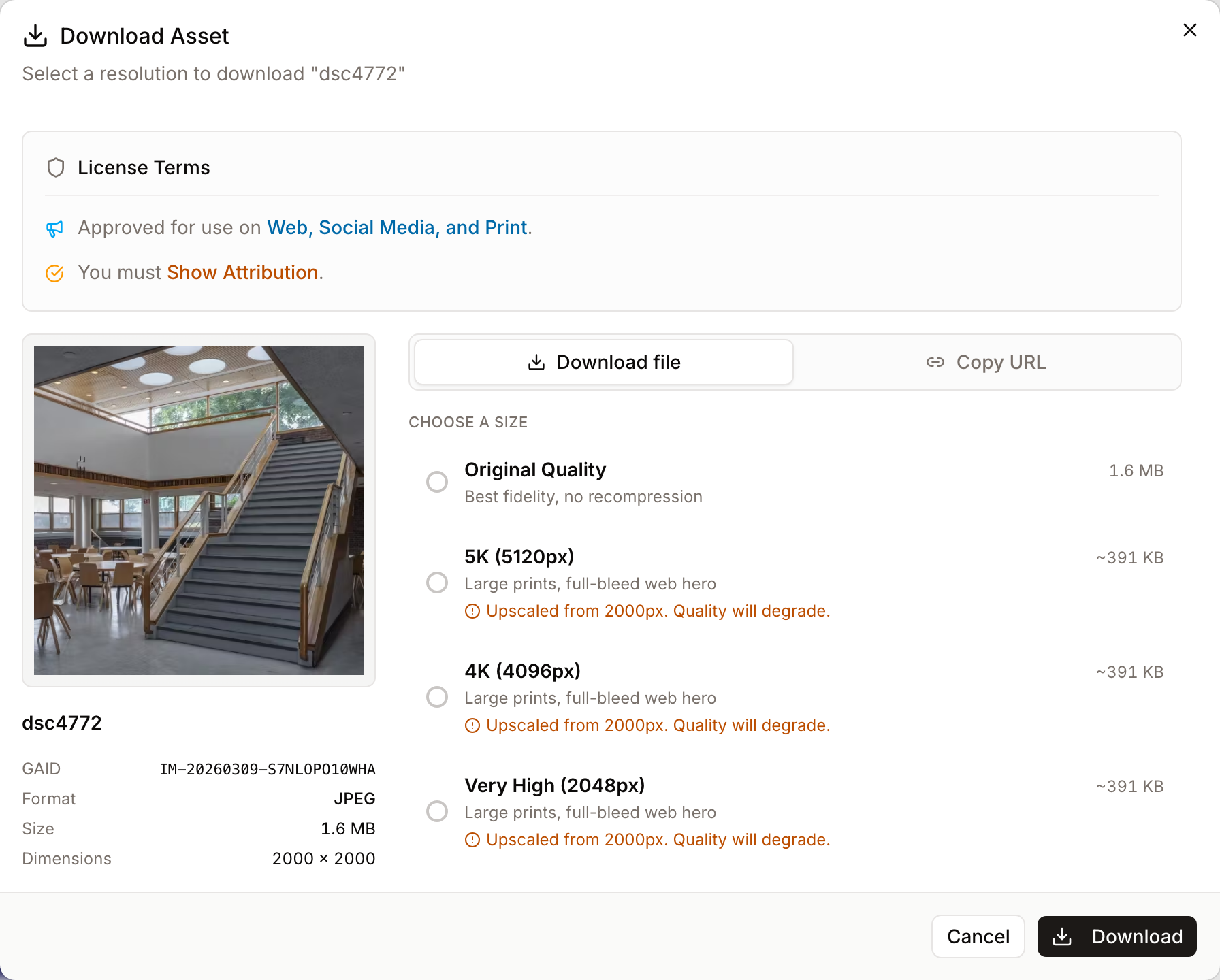
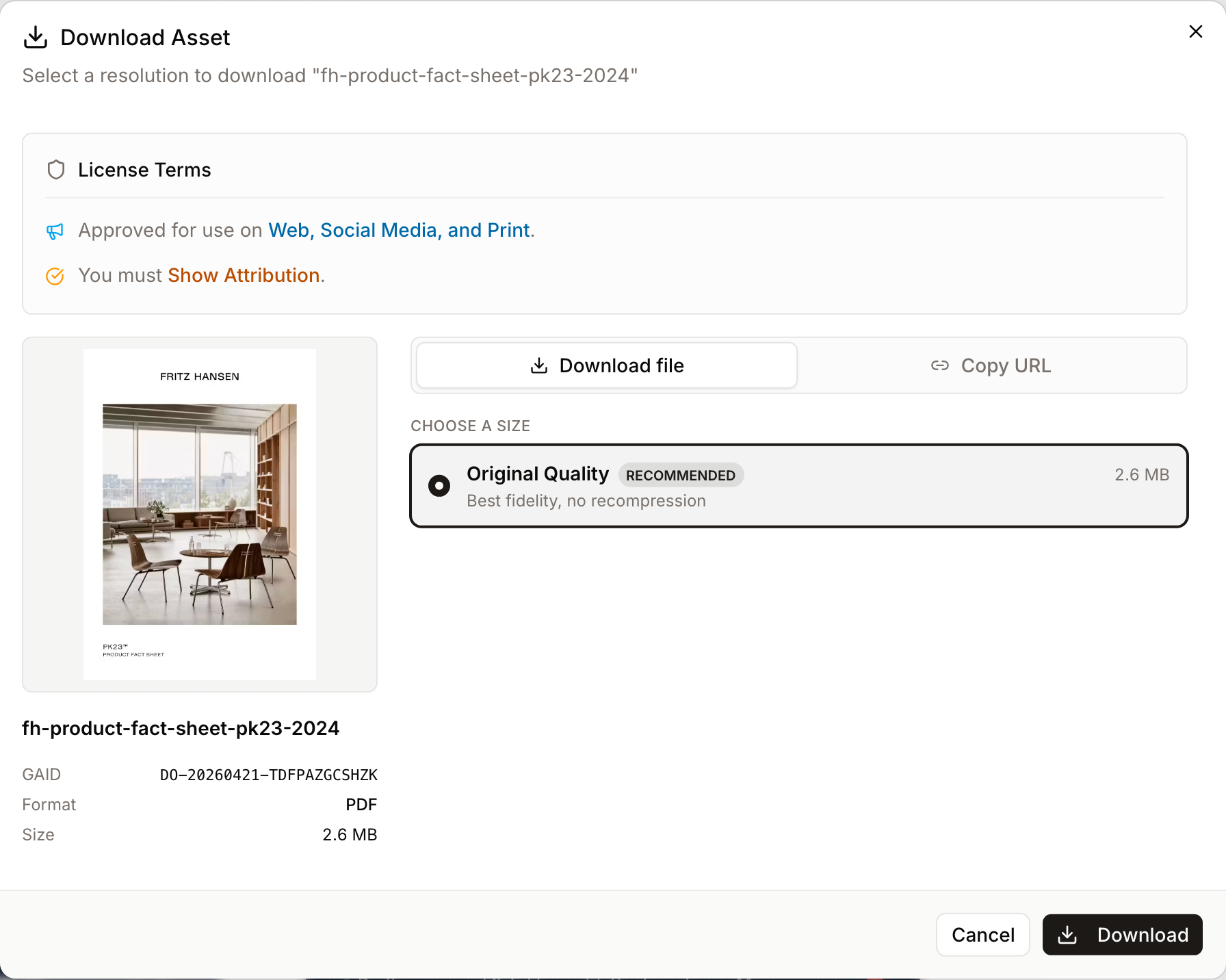
The single-asset variant is a two-column workbench:
- Left pane: a large preview of the asset, the asset title, identifier (GAID), file format, original file size, dimensions, asset type, and - when the asset has a rights policy attached - a full-width licence terms block sitting above the preview.
- Right pane: a mode toggle (Download file / Copy URL), a vertical list of available sizes, and the primary action button.
A moving highlight ring follows your selection as you click between sizes, so it's always clear which row is active.
Choosing a size
Each row in the size list shows:
- Label - Original, Largest (2048px), Extra Large (1024px), Large (512px), Medium (256px), Small (128px), and so on. The list is filtered to the resolutions your access tier allows.
- Short description - a one-line hint such as "Web hero, retina screens" or "Email, small social posts". This is meant to help you pick without having to remember what each pixel size is good for.
- Estimated file size - a projection based on the pixel count for the chosen size. The estimate uses the standard "WebP at quality 80" rule of thumb (about 0.1 bytes per pixel for natural images) and is shown so you can compare sizes at a glance. The actual file may be a little smaller or larger depending on the image content.
- Recommended badge - Freedam pre-selects a sensible default (the largest size at or below 2048 pixels). If the asset is smaller than every preset, the Original is selected instead so you never get an upscaled file.
- Best quality badge - appears on Original to flag it as the highest-fidelity option.
For vector files (SVG, AI, EPS) the dialog skips the "would be upscaled" warnings entirely - vectors re-rasterise cleanly from the source at any size, so every preset is sharp. A small note in the metadata pane labels these as Vector and explains this behaviour.
For print-only originals (PSD, TIFF, EPS, AI, RAW, HEIC) the Original entry is labelled "Source file, for editing apps (Photoshop, Illustrator, …). Not browser-renderable." Pick a rasterised size instead if you need something a browser, email client, or CMS can display.
Download mode vs Copy URL mode
The mode toggle at the top of the right pane switches what the primary action does without changing the selected size:
- Download file - clicking the button downloads the file at the selected size to your computer. This is the default mode.
- Copy URL - clicking the button copies a live Freedam CDN URL to your clipboard. You can paste the URL into a CMS, an email template, a Notion doc, or share it directly. Freedam delivers the image at the requested size on every request, so the URL always serves a fresh, on-spec version of the asset.
The CDN URL takes a familiar shape:
/i/original/{GAID}for the original file./i/w={pixels}/{GAID}for a specific rendered width (for example/i/w=1024/IM-20260309-UDXZH8PP6VPW)./assets/{GAID}/converted_pdffor the PDF version of an Office document.
You can only copy URLs in workspaces that have unauthenticated CDN delivery enabled. In share contexts that require a watermark, the copied URL always points at the watermarked endpoint.
Renderings (translations and alternative files)
When you download a single asset, the dialog lists its approved renderings in a Renderings group below the sizes - typically translations of a PDF, alternative crops, or social media formats. Each row shows the rendering's title, size, type and language. Select a rendering, then use the dialog's main download or copy URL button.
Renderings are independent files attached to the asset. Their URLs are not the CDN distribution URLs. For images, the file is a high-quality web version of the rendering. See Renderings.
License and rights terms
If the asset is governed by a rights policy, the dialog shows the policy's licence terms as a banner running across the top of the workbench. You'll see:
- The policy name and version.
- Expiration date and any usage restrictions.
- The full licence text rendered as readable Markdown.
When the policy requires an acknowledgement, the Download button stays disabled until you tick "I acknowledge the rights attached to this asset." Acknowledgements are recorded per asset, per policy version, and per user - your acknowledgement persists across future downloads of the same policy version, so you won't be asked twice for the same asset.
Download intent (when configured)
If your administrator has set up a download intent rule for the asset (or for everything matched by a particular access rule), the dialog inserts an extra step between picking a size and downloading the file:
- Usage category - a dropdown of common categories (Marketing campaign, Social media, Email marketing, Print, Web, Presentation, Edit/modify, Archive, Other) or a custom workspace vocabulary if your administrator has configured one.
- Additional details - optional free-text field for context (campaign name, project, etc.), capped at 500 characters.
- Territories and Channel - optional, only shown when the asset's rights policy ties usage to specific markets or channels.
- When will you use it? - optional timeframe: Immediate (today), This week, This month, Future use.
- Acknowledgement checkbox - present when the access rule sets "Require acknowledgement" and/or the rights policy needs a versioned consent.
You can Skip this step when the administrator marks every field as optional and no acknowledgement is required. Otherwise the Continue Download button stays disabled until the required fields are filled.
Intent details are recorded against the download event and feed into the Downloads analytics dashboard, so administrators can see what their library is actually being used for.
Requesting access for restricted assets
If you don't have permission to download an asset, the Download button is replaced by Request Access (with a lock icon). Clicking it opens the access-request variant of the dialog:
- Reason for request - a required text field, between 10 and 1,000 characters, where you explain why you need the asset.
- What happens next - a short summary of the workflow: the asset owner or an administrator reviews the request, you're notified by email, and approved requests arrive with download links valid for 24 hours by default.
- Press Cmd / Ctrl + Enter to submit without reaching for the mouse.
If the asset has both a download-intent rule and is restricted, you'll be asked for usage details first, then the access-request form - your usage details are forwarded to the reviewer along with your reason.
Bulk downloads
Selecting multiple assets in the Gallery and clicking Download opens the bulk variant of the dialog. Because a selection may contain a mix of images, animated GIFs, videos, audio files, and documents, the dialog groups your selection by type and gives you a per-type resolution control:
- Images - the resolutions your access tier supports, intersected across every selected image (you only see sizes that exist for every image in the group).
- Animated images - always download as the original file to preserve animation. There is no per-size choice.
- Videos - original only (videos don't have small / medium / large variants in Freedam).
- Documents & Other - download as the original format.
The dialog also shows an Excluded assets section listing any selection items you cannot download at your current access tier, so you can see exactly which assets will be skipped before you confirm. Bulk downloads always arrive as a ZIP file, which is built as it downloads, so the download starts straight away. To prepare a package in the background instead, with a metadata spreadsheet or previews, use Export.
If any asset in your selection requires approval, the bulk dialog routes to the access-request form instead - one request covers every restricted asset at once, and the reviewer sees the full list with thumbnails.
Watermarked share downloads
When you reach an asset through a public share link that requires a watermark, every download from the dialog is routed through the watermarked endpoint. The watermark is composited at download time using the share's configured layout, so:
- You don't pick whether the file is watermarked - the share enforces it.
- Copy URL produces a watermarked-CDN URL, so anyone you paste the URL to also gets the watermarked version.
- Videos, audio files, and documents are not downloadable from a watermarked share (the watermark pipeline only handles images).
Tips and Best Practices
- Use Copy URL for CMSes and emails. A CDN URL stays up to date with the asset - when someone replaces the file with a new version, the URL keeps serving the latest. Downloaded files don't.
- Acknowledgements stick. Once you've acknowledged a rights policy version for an asset, future downloads of the same asset and same policy version skip the acknowledgement step. Bumping the policy version asks you again.
- Vector assets are size-free. If you're working with an SVG or AI logo, pick any size - every rendition is generated from the vector source, so there's no quality trade-off.
- Bulk downloads stream straight to your browser. The ZIP is built while it downloads, so there is nothing to wait for in Freedam. For very large selections, Export prepares the ZIP in the background instead, and you download it when it is ready.
Troubleshooting
"Download not available" - no sizes shown
- Symptoms: The dialog opens but the size list is empty and the action button is disabled.
- Cause: Your access rule allows visibility but does not permit any download tier for this asset's type. For example, a "Watermarked preview" rule blocks video and document downloads outright.
- Fix: Click Request Access if it's visible, or contact your administrator. See Downloads by Asset Type for the full matrix of which tiers translate to which downloadable files.
Download arrives at a smaller size than the original
- Symptoms: You picked "Largest (2048px)" but the file you got is smaller.
- Cause: Freedam never upscales rasterised renditions. If the source image is, say, 1500 pixels wide, requesting a 2048-pixel rendition delivers the source at its native size instead.
- Fix: Pick Original if you need the source file at its true resolution. The recommended size already accounts for this - it's capped at the source width.
Copy URL pastes nothing or an error
- Symptoms: The "URL copied" toast doesn't appear, or you see "Unable to copy URL. Clipboard access is not available in this browser."
- Cause: Some browsers (or browser configurations) block clipboard access for non-HTTPS pages or for content rendered inside an iframe.
- Fix: Use the Download mode instead, or open the dialog in a top-level HTTPS browser tab.
Required acknowledgement won't enable the Download button
- Symptoms: You ticked the checkbox but the button stays disabled.
- Cause: There may be more than one acknowledgement required (a rule-level one and a separate rights-policy one), or the access rule has a required usage field you haven't filled in yet.
- Fix: Scroll through the dialog and make sure every required field - typically marked with a red asterisk - is filled. The Continue button enables as soon as the form is complete.
"Preparing download..." never finishes
- Symptoms: After clicking Download, the dialog stays on "Preparing download" for more than a minute.
- Cause: The size you picked is a lazy rendition that needs to be generated on the fly (this is common for unusual sizes or watermarked renditions that don't exist yet). The job is queued behind other work.
- Fix: Leave the toast notification visible - the file downloads as soon as the rendition finishes generating. If it takes more than a few minutes, ask an administrator to check the media-conversions queue.
See also
- Asset Detail - where the Download button lives on a single asset.
- Gallery & Search - selecting multiple assets and bulk-downloading them.
- Downloads by Asset Type - how administrators map quality tiers across images, videos, audio, and documents.
- Asset Requests - what happens on the administrator's side after you submit a Request Access form.
- Asset Access Rules - how visibility, download tiers, watermarks, and intent rules are configured.